Marketing Strategy for a New Website (The 5-Step Framework for B2B SaaS)
Iftikhar Ahmad Khan
Co-Founder & Content Strategist
Key Takeaways
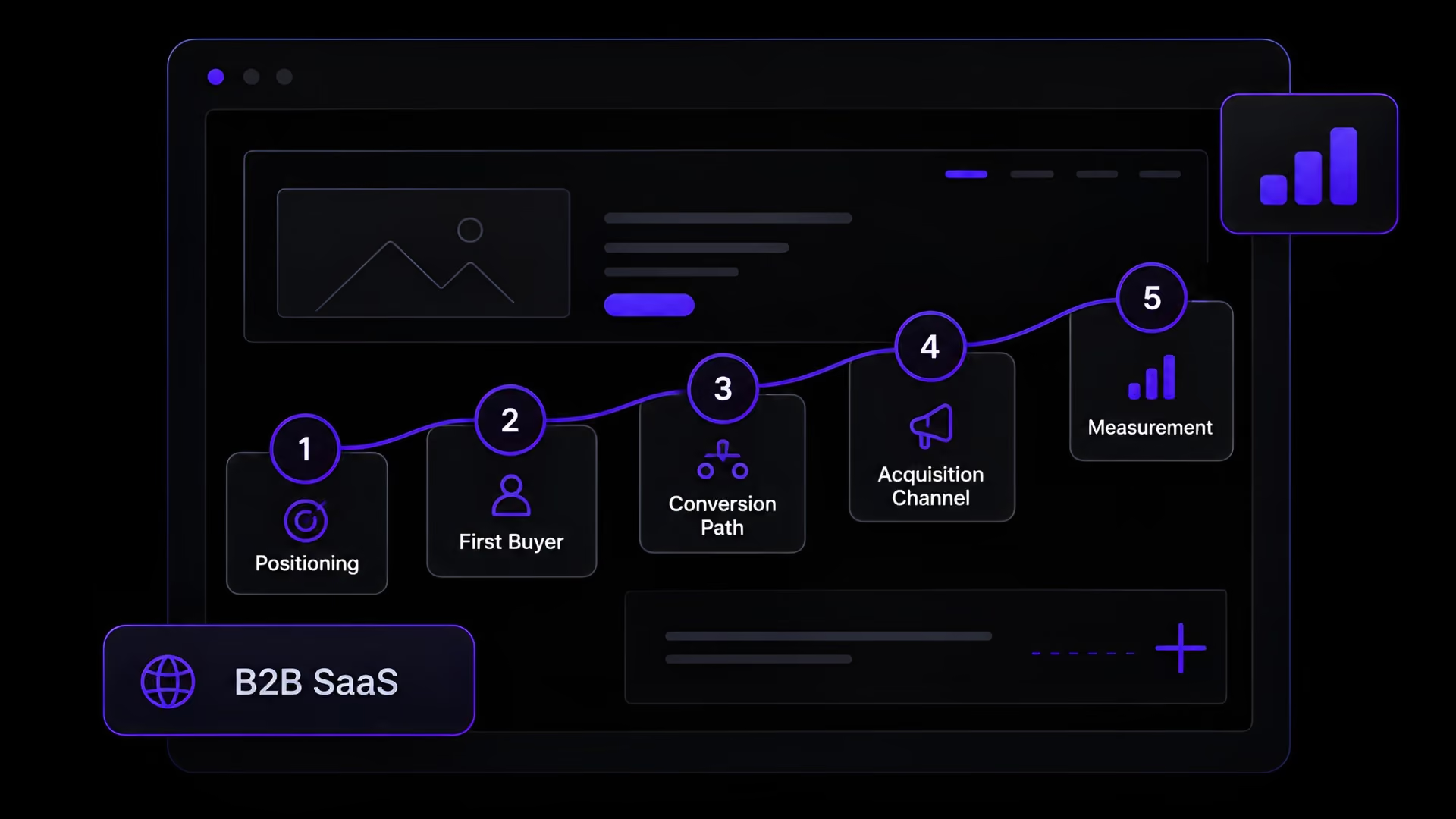
Make five decisions before design starts: Positioning, first buyer, conversion path, acquisition channel, and measurement. Each one shapes the website.
Start with the right category: Your category shapes how visitors understand your value, competitors, and price. If it is wrong, a better headline will not fix it.
Focus the homepage on one first buyer: Define them by company type, role, and buying trigger. Avoid broad audiences like “finance teams.”
Choose one primary action: Match the CTA to your sales motion: demo, trial, or waitlist. Too many CTAs split attention and make results harder to measure.
Prove one acquisition channel first: Do not rely on search for early pipeline. Ahrefs found that only 1.74% of newly published pages reached Google’s top 10 within a year.
Set up measurement and lead response before launch: Define MQLs, SQLs, tracking events, and lead ownership. Fast follow-up matters too. RevenueHero found that only 17.2% of B2B SaaS companies responded to a demo request within two minutes.
Forcing a new website to do two jobs at once can set up a weak launch. A site should never have to clarify your business model while simultaneously selling to your primary buyer.
When you let strategy follow design, you often end up with a home page full of vague copy and expensive rewrites six months later.
The website is where every acquisition channel ends. Ads land on it, outbound emails link to it, search engines index it, and AI tools read it when a buyer asks for a recommendation.
If the decisions behind those channels haven't been made, the site has to guess, and every page inherits the guess.
A marketing strategy for a new website comes down to five decisions, made in this order before design starts: positioning, first buyer, primary conversion path, primary acquisition channel, and measurement.
Launch planning, analytics, lead routing, and reviews follow.
If you came here asking how to promote a new site, that's decision four, and it works best after the first three.
What each decision settles on the site
Decision
The question it answers
What it settles on the website
1. Positioning
What are you, and why should anyone care?
The homepage claim, category language, navigation
2. First buyer
Who is the site speaking to?
The homepage's audience and voice, which audience pages exist
3. Primary conversion path
What should that person do next?
The main call to action, forms, sitemap by funnel stage
4. Primary acquisition channel
Where do visitors come from?
Which landing pages and templates get built first
5. Measurement
How will you know it's working?
Tracking, funnel stages, which pages carry which job
Decision 1: Positioning
Which market category your product competes in, what it claims inside that category, and why only you can make that claim.
Why the category you name shapes everything after it
The first line of your site names a category, and visitors fill in the rest. April Dunford notes that prospects assume things about value, competitors, features, and even pricing based on the market you name.
Dunford's own example makes the risk clear.
She joined a startup founded by database experts. Its product could analyze very large volumes of data quickly.
But prospects kept denying the meetings.
Why?
They heard database and immediately thought Oracle. That category came with its own expectations. They assumed the startup was another database product, another competitor, another version of something they already had.
Then the team changed the positioning. They stopped calling it a database and presented it as a business intelligence tool.
The product didn’t suddenly become more capable, but the category simply gave prospects a different way to understand what it was good at.
Your default category usually comes from where the product started. But the category that feels obvious internally can also be the category that makes the product hardest to understand.
How to choose a category
For SaaS website positioning, work through Dunford's five-step exercise.
Let go of where the product started, list what is unique about it, map that to customer value, identify who cares most about that value, then choose the category that makes the value obvious.
Keep this decision separate from the words on the page.
Dunford treats positioning as an input to messaging, with a separate messaging document built from it. B2B messaging only works once the category and claim are settled.
How to Tell if Your Headline Actually Differentiates You:
Ask what people disagree with. If they only disagree with how the headline is worded, you have a copy problem. If they disagree about who the product is for or what category it belongs to, you have a positioning problem.
Compare your headline with three competitors. Hide the company names and read the headlines side by side. If you could put a competitor's name on your headline and it would still make sense, your headline is not differentiating you.
What positioning changes on the website
Positioning affects more than the homepage headline.
SaaS website positioning shapes the category words you use in your navigation and page titles, the competitors you compare yourself with and the pages you create around those comparisons.
It also tells you what to leave out.
If a feature does not support the position you want to own, it does not need to take up space on the homepage.
Target the precise buyer you can win first by focusing on their company type, professional role, and the exact trigger event driving them to seek your product.
Why a narrow first buyer beats a broad market
Dunford argues that well-matched buyers understand your value faster, buy faster, and ask for fewer discounts. She also treats a label like small businesses as too broad to act on.
A site written for everyone leaves each visitor to work out whether it applies to them.
How to identify the target buyer for a B2B SaaS website
Identifying the target buyer for a B2B SaaS website starts with narrowing the field.
Dunford's who cares test is simple. Imagine you have to sell as much as possible this month.
Who would you call first?
If you have no customers yet, look at your early conversations, pilots and design-partner calls.
Which prospects understood the product fastest?
Which ones immediately saw why they needed it?
Then describe that buyer in a way someone else could recognize. Include the company type, the person's role, and the trigger that makes them look for a solution.
Mid-market companies that need better analytics is too broad. It does not tell you which companies, which people, or what happened to make them start looking.
Who is the homepage really supposed to speak to first
Speak to one primary buyer on your homepage using their unique vocabulary, everyday problems, and operational situation. Build separate pages for technical evaluators or finance approvers to protect your core positioning from getting diluted.
Decision 3: Primary conversion path
Define the single primary action your site exists to drive, such as booking a demo, starting a free trial or joining a waitlist. Clearly state the immediate value the visitor receives in exchange.
A site becomes one of the high-converting websites in its category because the positioning, buyer, message, CTA, and acquisition source reinforce one another.
Why one action beats four
Decision 2 settled who the site speaks to. This one settles what that person does next. Every channel ends at the same site, so the conversion path is where each channel's results are.
Too many equal CTAs split attention. A demo, trial, waitlist, and newsletter should not all compete for the same visitor.
That makes SaaS homepage conversion harder to understand because you no longer have a clear primary action to measure. It also becomes harder to track what each channel actually produces.
How to choose between demo, trial, and waitlist
Follow the sales motion.
A sales-led product with a longer evaluation process should lead with a demo request. A product that someone can understand and try on their own should lead with a trial.
A product that is not ready for either can use a waitlist.
If the motion is mixed, which is common in seed to Series B companies, choose one primary action for the homepage and move the secondary action lower on the site, such as to the pricing page.
Before positioning the product as self-serve, make sure the product can deliver a self-serve experience:
Can a first-time visitor say what it does within seconds?
Can they start without talking to anyone?
Can they reach first value in minutes?
Is there a self-serve way to pay, upgrade, and downgrade?
Does using the product spread it to others?
Mostly no means lead with a demo.
What the conversion path changes on the sitemap
Sort pages by what the visitor is trying to do:
Discover: Guides, glossary pages, and educational content help people understand the problem.
Evaluate: Product, pricing, alternatives and case studies help people decide whether you are the right fit.
Convert: Demo and signup pages make it easy to take the next step.
The homepage mostly routes visitors to the right place.
The pages that persuade people already evaluating you deserve the most design and writing time, especially product, pricing, comparison, and case-study pages.
Generic SaaS homepage conversion benchmarks can be misleading because conversion rates vary by traffic source, sales motion, and product.
Your channel-level conversion rate will tell you more.
Plan comparison and case-study pages now
A comparison page earns trust by being honest about trade-offs. A case study works best as problem, implementation, and result, with real numbers.
These are the kinds of SaaS website best practices that make the site useful during evaluation, rather than simply making it look complete.
Decision 4: Primary acquisition channel
Which acquisition channel will you prove first?
For B2B SaaS lead generation, the answer isn't simply which channel can generate the most traffic. It is which channel can bring the right buyers to a site built to convert them.
This is where you focus your limited time and budget until you know it can support your goal. The answer can change as the company grows.
Why the channel comes before the site
Your acquisition channel shapes what the website needs to do because the website is where that channel leads people.
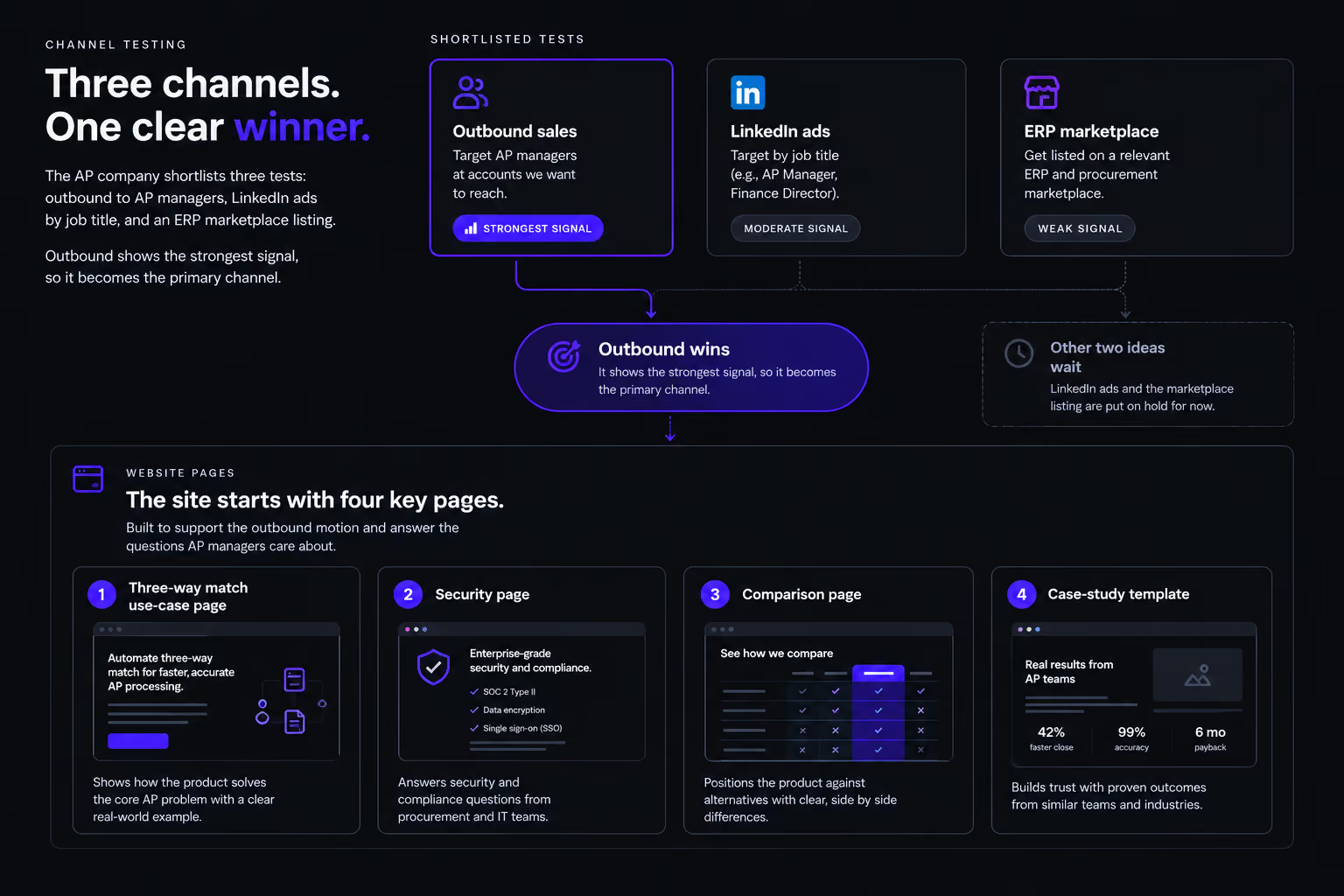
Outbound may need focused pages that sales reps can send after a conversation. Paid search may need landing pages that closely match the promise made in each ad.
Trying to build for several unproven channels at once spreads your resources and makes it harder to learn what is actually working.
That is one of the core ideas behind Traction by Gabriel Weinberg and Justin Mares.
For a B2B website growth strategy, the practical takeaway is simple. Prove one primary channel first, then expand into others as you learn what works.
How to choose a channel with Bullseye
Weinberg described the Bullseye process in a 2015 interview.
Brainstorm a test for each of the book's 19 channels, shortlist about three, run them as cheap, fast tests in parallel, then commit to the strongest.
Each test should answer:
What a customer costs
How many customers the channel could bring
Whether they're the right ones
This comes from the authors' experience, not measured data and Weinberg's account shows why the winner is a bet to verify.
He said DuckDuckGo had switched its main channel six times by 2015. On their own book, blog posts and social ads didn't convert, but podcasts did.
Expect your primary channel to change as you grow.
Where search fits for a new domain
If search is on your shortlist, set expectations first.
B2B SEO best practices still matter, such as clear product and category pages, useful comparison content, internal linking, and evidence that helps buyers evaluate the product.
However, SEO is a compounding channel rather than an instant source of pipeline.
Ahrefs found that 1.74% of newly published pages reached Google's top 10 within a year.
Under a different filter, the figure was 6.11%, which Ahrefs suggests may be the fairer number. It also found that 72.9% of top-10 pages are more than three years old.
The study measures pages, not new domains, but the implication holds. Search is usually a channel to start building, not one to rely on for an early pipeline.
Start anyway, because search visibility now relies on both traditional rankings and AI retrieval.
Evidence on what AI tools cite is still early.
The pages most likely to help are also the ones buyers read, including clear product and category pages, comparison pages, pricing, and first-party evidence such as original data and case studies.
What each channel needs from the site
Choose the channel first, then build the site around it. This table is a working recommendation based on how each channel sends people to a site, not a tested standard
Channel
What the site needs
Pages that matter most
Outbound sales
Pages a rep can link to after a call, a clear route to book time, answers to security and procurement questions
Use-case pages, case studies, security page
Paid search
One landing page per intent group (competitor alternatives, category terms), copy that matches the ad, a visible route to pricing
A home for data and reports that can be linked and cited, with the method shown
Research hub, report pages
Decision 5: Measurement
What success looks like at each funnel stage, and which numbers you'll read to judge the channel and the pages, set before the build.
Why measurement is a decision, not a dashboard
Decisions one through four are hypotheses.
Without a measurement decision, you can't tell which one was wrong. You end up judging the launch by how it feels instead of what the results tell you.
Measurement also has to define what counts as a qualified lead. That is where the difference between a marketing qualified lead and a sales qualified lead matters.
An MQL is a lead marketing considers more likely to buy than an average visitor, based on fit and behavior. An SQL is a lead sales has reviewed and accepted as a real opportunity.
The criteria differ by company.
If marketing counts every webinar attendee as an MQL while sales expects a prospect to have budget and a timeline, each team will think the other is failing.
How to set stage metrics and lead definitions
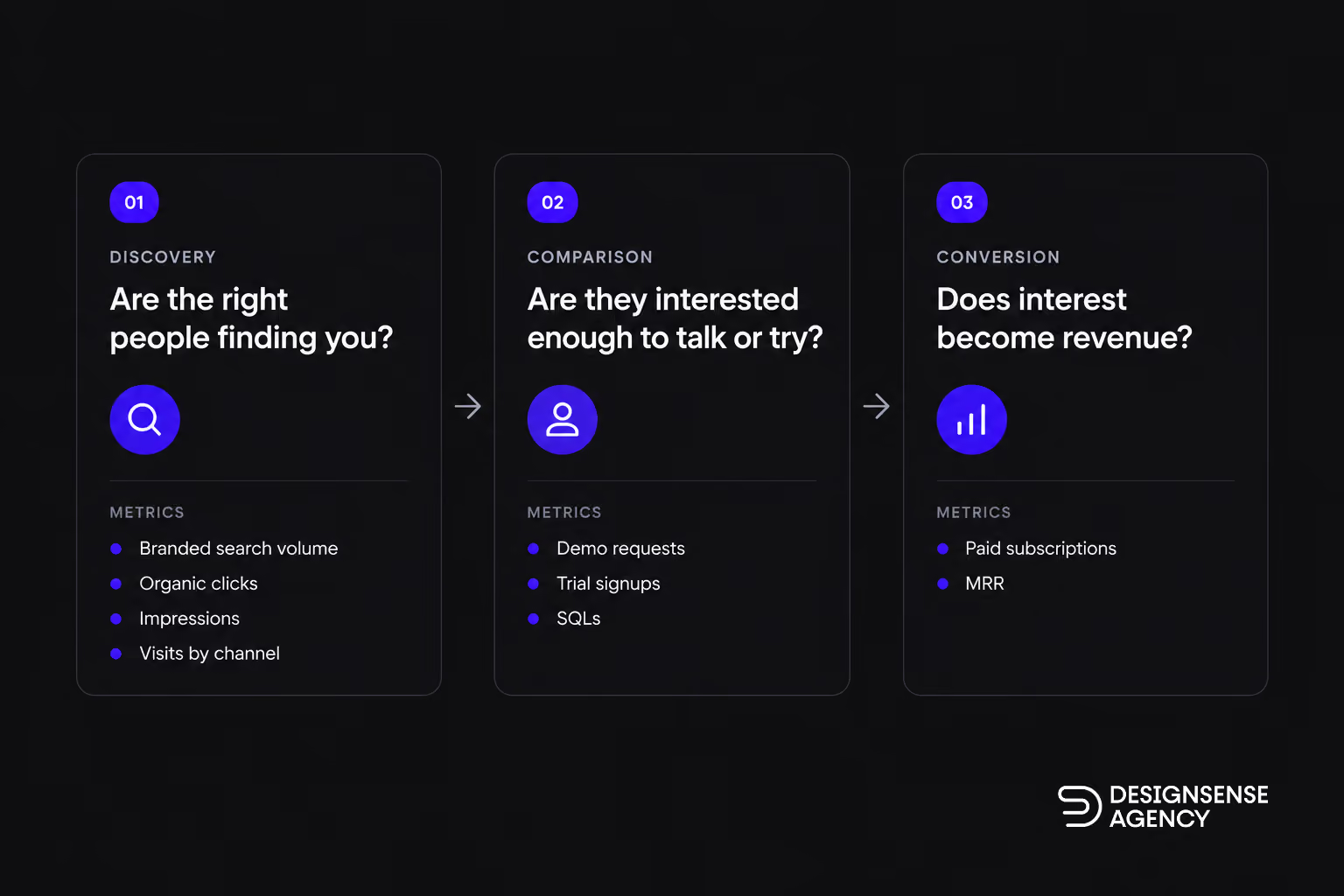
Set a goal and a metric for each stage.
Measure conversion across every stage by channel and page. Use channel data to validate your primary acquisition source and page-level data to find bottlenecks.
Set clear marketing and sales qualification criteria, along with defined routing for leads that don't qualify.
Why early traffic limits what you can test
When traffic is low, conversion rates can move dramatically because of only a few actions. A page with 200 visits and two demo requests converts at 1%. Add one more request and the rate jumps to 1.5%.
With numbers this small, testing headlines, button copy, or minor design changes often produces results that are difficult to separate from normal variation.
That does not mean measurement is unimportant. It means early-stage teams should prioritize stronger signals, such as the quality of leads, patterns in sales calls, recurring questions from prospects, and whether the channel is attracting the intended buyers.
Run A/B tests when traffic and conversion volume are high enough for differences between variations to be measured with greater confidence.
What measurement changes on the site
Measurement becomes part of the site architecture from the start.
Before development, define the events you need to track, including important page views, form submissions, demo bookings, and signups, while preserving the source of every lead.
Assign each page a funnel stage and a metric so you know what its job is. Once the site launches, the first week's data is already gone if you weren't tracking it.
From decisions to launch
The five decisions are the strategy. What follows is implementation, and it goes smoothly only once the decisions are made.
Work in dependency order
Each step builds on the one before it. Start with positioning, then define the message, turn that into copy and design, set up the acquisition channel, launch, and review the results.
If you change the positioning late, the decisions that follow it may need to change too.
The timeline below is only an example. The exact number of days can change. What matters most is doing the work in the right order.
When
Work
Weeks 10–6 before launch
Make and sign off the five decisions
Weeks 6–2
Sitemap, copy, design, build; tracking plan implemented
Weeks 2–1
QA; test every form and event end-to-end; brief sales
Launch week
Publish, check tracking, fix bugs; no new decisions
Days 30, 60, 90
Reviews
Keep positioning debates out of launch week
Name one owner per decision and write down the date it's locked. Reopen a locked decision only for new evidence, such as something a customer said or a number from a test.
Decide who answers every lead, and how fast
Trace one lead end-to-end before launch, covering the form, where the submission routes, who owns the response and where the outcome is recorded.
Speed matters once a visitor raises their hand.
InsideSales analyzed 5.7 million inbound leads and more than 55 million sales activities across 400+ companies.
Leads that received a contact attempt within five minutes had conversion rates more than eight times higher than leads contacted after six minutes or more.
The study is broader than SaaS, but the scale makes it useful evidence that the value of an inbound lead can fall quickly once the response is delayed.
More recent research shows the problem is still widespread in B2B SaaS.
In 2024, RevenueHero submitted demo requests to 1,000 B2B SaaS companies. Only 17.2% responded within two minutes, while 63.5% never responded at all. Among the companies that did respond, the average response time was 1 day, 5 hours, and 17 minutes.
For a new SaaS website, that makes response time part of the conversion system, not just a sales operations issue.
A demo request that sits in a CRM for hours is not the same conversion opportunity as one that reaches the right person while the buyer is still actively evaluating options.
Review at 30, 60, and 90 days
Ask the same five questions each time:
Did the site hit the goal set before launch?
Which channel produced the best-quality conversions?
What did prospects fail to understand?
Which pages underperformed: the page, the traffic, or the offer?
Which locked decision needs revisiting and on what evidence?
Thirty days is mostly about fixing tracking and friction. By 90, you may have enough evidence to revisit positioning, which Dunford argues should happen as markets shift.
The website is the system, not the strategy
The website is the system built from the marketing strategy. The five decisions determine what the site says, who it speaks to, what action it drives, where visitors come from, and how success is measured.
Make these decisions before the build.
Otherwise, launch week becomes the point when you're still figuring out the strategy while traffic is already arriving.
Once positioning, buyer, conversion path, channel, and measurement are settled, DesignSense turns them into website structure, messaging, conversion paths, design, and Webflow or Framer development for B2B SaaS companies.
If you're still working through the five decisions, the sections above are the place to start.
If they're made and you're ready to build, see B2B SaaS web design, or startup web design if you're earlier stage.
FAQ
What is a marketing strategy for a new website?
It's a set of decisions made before the build: what the site claims, who it targets first, what action it exists to produce, which channel will send visitors, and how results will be measured. The site is built from those decisions instead of being promoted after the fact.
How do you promote a new B2B SaaS website?
Choose one primary channel to prove first, and test it cheaply before committing. The Bullseye process in Traction suggests running small tests on about three channels, then focusing on the strongest. Don't rely on organic search for early pipeline. Ahrefs found that 1.74% of newly published pages reached Google's top 10 within a year, or 6.11% under a different filter.
How do you identify the target buyer for a B2B SaaS company?
Start with the prospects who grasp your unique value fastest, and describe them by company type, role, and trigger. Dunford argues that broad labels aren't specific enough, and that well-matched buyers buy faster and discount less.
How long does a new website take to rank on Google?
No source gives a reliable answer for a specific site. Ahrefs found that 1.74% of newly published pages reached the top 10 within a year (6.11% under a different filter), and that 72.9% of top-10 pages are more than three years old. Build search assets early, and plan an early pipeline around another channel.